




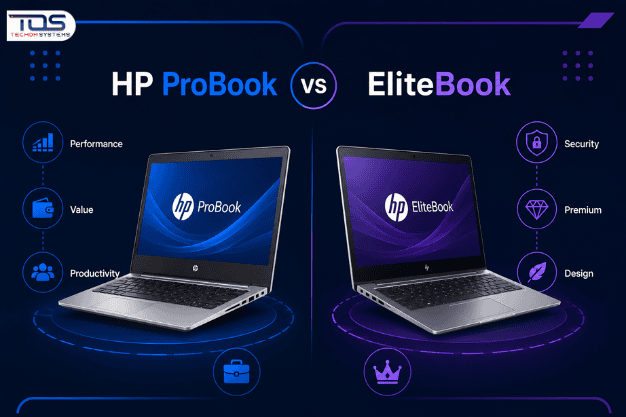
The HP ProBook vs EliteBook decision lands on most IT Managers’ desks the moment a fleet refresh gets approved. It’s not a specs debate. It’s a budget-versus-risk call that shapes help desk load, security posture, and replacement cycles for the next three to four years.
Get it wrong and you will know quickly, either through a blown budget or a spike in support tickets from underpowered machines. The safest starting point is the full HP ProBook vs EliteBook range at TECHOM Shop, where current stock, pricing, and specifications sit side by side rather than scattered across separate product pages.
What Actually Separates These Two Series
Both series run on the same Intel Core Ultra platform used across HP’s current business line-up, including on-device AI processing through an integrated NPU. The difference is not raw horsepower. It’s how that platform is packaged.
ProBook models focus that budget on core productivity: a 16-inch display for admin-heavy roles, solid battery life, and enough security to pass a standard IT audit. EliteBook models redirect the same budget toward chassis durability, deeper endpoint protection, and a 14-inch form factor built for travel.
- Productivity: Both series handle Microsoft 365, Teams, and browser-based ERP work without lag.
- Security: EliteBook adds privacy screens and deeper Wolf Security controls as standard.
- Scalability: A single SKU per role speeds up imaging and warranty tracking at fleet scale.
- Total cost of ownership: Chassis durability, not the CPU, drives most of the cost gap.
HP ProBook: The Volume Workhorse
The ProBook range suits roles where twenty identical laptops matter more than any single premium feature. Think reception, data entry, call centre seats, and field staff running standard office software.
ProBook devices still ship with HP Wolf Security essentials, fingerprint login, and remote manageability through common MDM platforms. They simply skip the chassis-grade extras EliteBook buyers pay for. On the HP ProBook vs EliteBook scorecard, this is where a Procurement Manager protects margin without cutting corners on support.
HP EliteBook: The Risk-Sensitive Choice
EliteBook models earn their price premium in roles where a stolen laptop or a cracked hinge carries real cost. Finance, legal, healthcare, and client-facing consultants sit squarely in this bracket.
Advanced security layers, premium materials, and enhanced manageability make EliteBook devices suited to executives and remote workers handling sensitive data. This is the other side of the HP ProBook vs EliteBook comparison that enterprise buyers weigh most heavily.
HP ProBook vs EliteBook: Side-by-Side Comparison
The table below summarises how each series typically performs against the factors procurement teams care about most.
| Consideration | HP ProBook | HP EliteBook |
|---|---|---|
| Best suited for | SMEs and everyday business use | Enterprise and regulated industries |
| Security features | Standard business-grade security | Advanced, layered security controls |
| Build and durability | Business-grade construction | Premium materials, MIL-STD tested |
| Manageability | IT-friendly, easy to support | Built for large-scale fleet management |
| Typical buyer | Growing teams, cost-conscious IT | CIOs, compliance-driven organisations |
| Investment level | Moderate upfront cost | Higher cost, justified by longevity |
This comparison shows why the HP ProBook vs EliteBook decision is not about which series is better overall. It’s about matching specification to role, budget, and risk profile.

A Practical Business Scenario
Picture a 60-person accounting firm upgrading its fleet ahead of tax season. Forty-five staff in reception, admin, and junior accounting roles need machines for Xero, email, and back-to-back Teams calls. A ProBook rollout covers that group at a per-unit cost the finance team can defend without a business case.
Twelve senior accountants and three partners handle client tax file numbers and travel to client sites weekly. For that group, an EliteBook’s privacy screen and stronger endpoint protection justify the higher per-unit spend. This is the HP ProBook vs EliteBook decision playing out exactly as procurement teams see it in practice, not as a theoretical comparison.
This split-fleet approach is now the norm rather than the exception. Most Australian mid-market firms run both series side by side, assigned by role rather than by seniority alone.
Security and Manageability: A Procurement Priority
IT Managers increasingly treat security as a line item in the purchase order, not a policy bolted on afterwards. Both series ship with HP’s Wolf Security stack, but the coverage depth is where the real HP ProBook vs EliteBook split shows up.
- HP ProBook: Standard biometric login, HP Wolf Security essentials, and remote manageability.
- HP EliteBook: Advanced privacy screens, deeper endpoint protection, and enhanced device-level controls.
For businesses in finance, legal, or government-adjacent sectors, EliteBook’s additional layers often align better with compliance obligations.
Scalability and Long-Term Investment
Fleet decisions should account for growth, not just current headcount. Standardising on a single series simplifies imaging, support, and warranty management as the business scales.
Some organisations start with ProBook fleets and shift toward EliteBook as they take on larger clients or stricter data-handling requirements. Planning for this transition early avoids disruptive mid-cycle changes.
Procurement teams weighing HP ProBook vs EliteBook long term should also factor in warranty terms, parts availability, and vendor support responsiveness. All of these affect uptime.
Total Cost of Ownership and Return on Investment
Purchase price is only one line in the budget. Support costs, downtime, and replacement cycles usually matter more over a three-year term. A well-matched device pays for itself through fewer repairs and less lost productivity.
ProBook devices typically offer a lower entry cost and a shorter payback period for standard business roles. EliteBook devices cost more upfront but often deliver a longer service life, which can lower the effective cost per year for demanding users.
When IT Managers model total cost of ownership, the HP ProBook vs EliteBook numbers should include warranty coverage, expected refresh cycles, and the cost of unplanned downtime. These factors often shift the outcome more than the sticker price alone.
Deployment and Compatibility Considerations
Both series enrol through Windows Autopilot and standard MDM platforms like Intune, so a fleet of either model drops into an existing IT stack without custom scripting.
Dock and peripheral compatibility still needs a check before the purchase order goes out. Confirm Thunderbolt or USB-C dock support against your existing monitor and docking hardware, since a mismatch here delays rollout more often than the laptop choice itself.
Support, Warranty, and Vendor Reliability
Specifications only tell half the story. Warranty terms, local support, and onshore spare-parts stock determine how fast a device gets back into service after a fault.
Working with an Australian-based supplier, rather than an overseas reseller, usually means faster replacement turnaround and someone local to escalate to when a warranty claim stalls.
Before signing off on either series, ask your supplier three things: average repair turnaround, whether loan devices are provided during claims, and whether stock is held onshore or shipped in on demand.
Which HP Model Should Your Business Choose?
Once you have weighed the HP ProBook vs EliteBook trade-offs against your budget and risk profile, picking a specific model gets a lot simpler.
For teams needing dependable everyday performance without unnecessary cost, the HP ProBook 4 G2i (SKU: E0EP4PT) is a strong option. It suits growing businesses, administrative teams, and departments with standard productivity needs.
For executives, remote staff handling sensitive data, or organisations with strict compliance requirements, the HP EliteBook 8 G2i (SKU: DX9B1PT) delivers the added security, durability, and performance headroom that enterprise buyers expect.
Both models are available through TECHOM Systems Shop, alongside the full HP Business Laptops range, making it easier to standardise your fleet with confidence.
Frequently Asked Questions
#1. Is HP ProBook vs EliteBook mainly a price difference?
Price is one factor, but the real difference lies in security depth, build materials, and manageability features suited to different business risk levels.
#2. Can a business run both ProBook and EliteBook devices together?
Yes. Many organisations assign ProBook devices to general staff and EliteBook devices to executives or roles handling sensitive information.
#3. How do I decide which HP series suits my organisation?
Start by reviewing security requirements, user roles, and budget. A quick consultation with a business technology supplier can speed up this process considerably.
Make an Informed HP ProBook vs EliteBook Decision
Choosing between these two series should not slow down your procurement timeline. With the right guidance, matching devices to roles becomes straightforward.
TECHOM Shop works with Australian businesses to simplify HP laptop procurement, from single units to enterprise-wide rollouts.
Ready to move forward? Explore the full range of HP Business Laptops, compare the HP EliteBook 8 G2i and HP ProBook 4 G2i, check current availability, or Get a Quote tailored to your organisation’s needs today.

Peter Pawlak, Director of Sales and Customer Advocate, brings over 15 years of experience helping ambitious business owners grow with confidence. His mission is to empower people to start, build, and run their businesses successfully, turning ideas into thriving ventures. Peter’s passion for business transformation and his results-driven approach have been key to guiding entrepreneurs toward faster and smarter growth.