




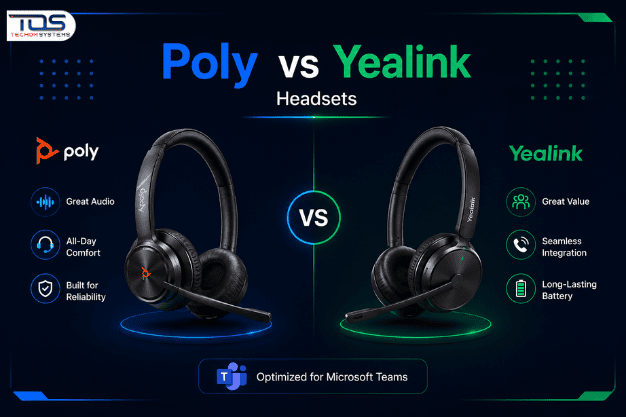
The Poly vs Yealink Headsets decision comes up every time a business plans a communications refresh. Both brands sit at the top of the enterprise audio market, and both carry Microsoft Teams certification across most of their range. The right choice depends less on brand reputation and more on how your teams actually work.
Contact centres, hybrid staff, and meeting-heavy executives all place different demands on a headset. A Poly vs Yealink Headsets comparison only earns its keep when it’s mapped against those real roles, not just a spec sheet.
Why Headset Choice Affects Business Outcomes
A headset looks like a minor line item next to laptops and monitors. In practice, it shapes call quality, meeting fatigue, and how many help desk tickets your IT team fields each month.
Poor audio equipment creates real cost. Dropped calls, muffled voices, and repeated complaints eat into productive hours across the business. Getting the Poly vs Yealink Headsets choice right protects both budget and productivity from day one.
- Productivity: Clear audio reduces repeated questions and meeting fatigue.
- Support load: Certified devices generate fewer help desk tickets.
- Employee experience: Comfort affects adoption, especially for all-day wear.
- Brand consistency: Standardising on one range simplifies training and support.
Why Is My Headset Not Working? Common Workplace Audio Challenges
This is one of the most common tickets IT teams field. The honest answer to Why is My Headset Not Working? usually traces back to one of a handful of root causes, not a faulty unit.
- Certification mismatch: An uncertified headset paired with Teams can drop call controls or mute status.
- Driver and firmware gaps: Outdated firmware causes intermittent audio or connection drops.
- Bluetooth interference: Crowded open-plan offices can disrupt wireless pairing.
- Device switching: Staff moving between laptop and desk phone without proper profiles.
IT Managers who standardise on certified Poly or Yealink models see a real drop in these tickets. Fewer “why is my headset not working” calls free up help desk time for higher-value work.
Microsoft Teams Certification and Why It Matters for Procurement
Most modern offices run on Microsoft Teams, so certification is not a nice-to-have. It’s the baseline that determines whether a headset just works or becomes a support headache.
Poly and Yealink both hold Microsoft Teams Open Office certification across key models. That certification covers call controls, LED status lights, and native compatibility without third-party drivers.
Procurement teams should confirm certification model-by-model rather than assuming brand-wide coverage. A single uncertified unit in a fleet order can quietly generate a wave of “why is my headset not working” tickets after rollout. This is where the Poly vs Yealink Headsets decision starts to matter at a practical level, not just a budget one.
Audio Quality, Noise Cancellation, and Call Clarity
Poly built its reputation on premium acoustic engineering, and that shows in open-plan office and contact centre models. Active noise cancellation and studio-tuned microphones handle busy backgrounds well.
Yealink has closed much of that gap in recent generations, particularly in its UH-series headsets. Dual-microphone noise cancellation now delivers business-grade clarity at a lower price point.
For roles where every call matters, like sales and client-facing teams, the audio gap in the Poly vs Yealink Headsets comparison is smaller than it was two or three years ago.
Comfort and Hybrid Work Performance
Comfort determines whether a headset actually gets worn, not just issued. All-day meeting schedules make lightweight design and cushioned ear cups a genuine productivity factor.
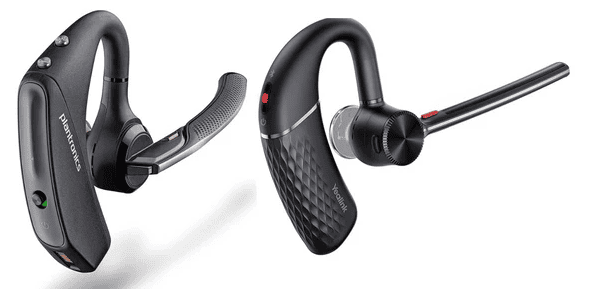
Poly’s BackBeat and Blackwire ranges lean into lightweight, all-day comfort, which suits hybrid staff moving between home and office. Yealink’s mono headsets favour single-ear designs for staff who need situational awareness, such as reception or trading floor roles.
Comfort rarely triggers a why is headset not working ticket on its own, but poor fit still drives low adoption and staff reverting to phone speakers. Comfort is often where the Poly vs Yealink Headsets choice feels most personal, not just technical.
Poly vs Yealink Headsets: Side-by-Side Comparison
The table below summarises how each brand typically performs against the factors procurement teams care about most.
| Consideration | Poly | Yealink |
|---|---|---|
Best suited for | Hybrid knowledge workers, executives | Cost-conscious teams, contact centres |
Teams certification | Broad coverage, premium tier | Broad coverage, value tier |
Audio engineering | Studio-grade, strong ANC focus | Strong clarity, closing the gap |
Comfort | Lightweight, all-day design | Practical, task-focused design |
Device management | Poly Lens platform | Yealink management platform |
Typical buyer | Enterprises, CX-focused teams | SMEs, high-volume deployments |
Investment level | Higher, premium features | Moderate, value-driven |
This comparison shows why Poly vs Yealink Headsets is not a contest with one clear winner. It’s a matter of matching acoustic performance and price to the role.
Device Management, Security, and Deployment at Scale
Rolling out headsets to fifty staff is a different challenge to fitting out five. Centralised management determines how quickly IT can push firmware updates and monitor device health.
Poly Lens gives IT teams fleet-wide visibility, remote firmware updates, and usage analytics across Poly devices. Yealink offers similar centralised control through its own management platform, which suits businesses standardising on Yealink desk phones and headsets together. Fleet management capability is a growing factor in the Poly vs Yealink Headsets decision for IT teams running mixed device estates.
Good fleet visibility also answers for headset not working question before staff even raise a ticket, since IT can spot firmware gaps proactively.
Security matters too. Both brands support encrypted call paths and enterprise authentication, which keeps procurement and compliance teams comfortable signing off on a fleet order.
Reliability, Scalability, and Total Cost of Ownership
Reliability is where the Poly vs Yealink Headsets comparison often gets decided. A cheaper headset that fails within eighteen months costs more in replacements and downtime than a slightly pricier unit that lasts three years. Poly devices generally carry a premium build reputation, backed by longer warranty terms on select models. Yealink devices offer strong reliability at a lower price point, which suits businesses scaling headset numbers quickly.
A high replacement rate often traces back to the same Why is my headset not working complaints, usually tied to certification mismatches rather than hardware failure. Total cost of ownership should include replacement rate, support tickets, and warranty claims, not just the unit price on the purchase order.
A Practical Business Scenario
Picture a 100-seat customer service centre alongside a 20-person executive team. Agents take back-to-back calls for eight hours a day, where mono headsets suit long shifts and situational awareness matters.
A Yealink-style mono headset suits that high-volume, cost-sensitive rollout well. The executive team spends most of the day in Teams meetings, moving between office and home.
For that smaller group, a Poly wireless or wired model offers the comfort and audio quality that suits premium, meeting-heavy roles. This scenario captures the Poly vs Yealink Headsets decision as it plays out across a real, mixed workforce.
Matching the Right Model to the Role
Once you have weighed the Poly vs Yealink Headsets trade-offs against role and budget, choosing a specific model gets much easier.
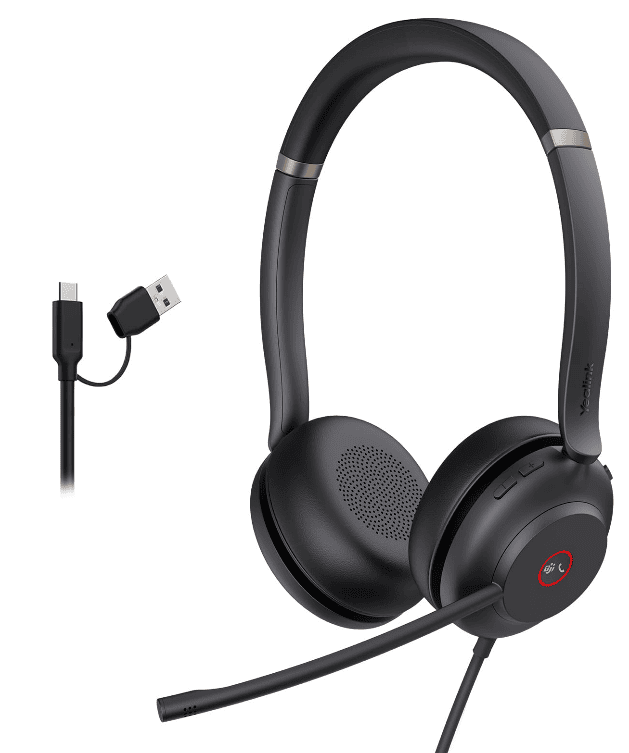
For agents and desk-based staff who need a reliable wired connection, the Yealink UH44 Mono Headset (SKU: UH44-M-C/A) delivers dependable call quality without wireless complexity. It suits high-volume, cost-conscious rollouts.
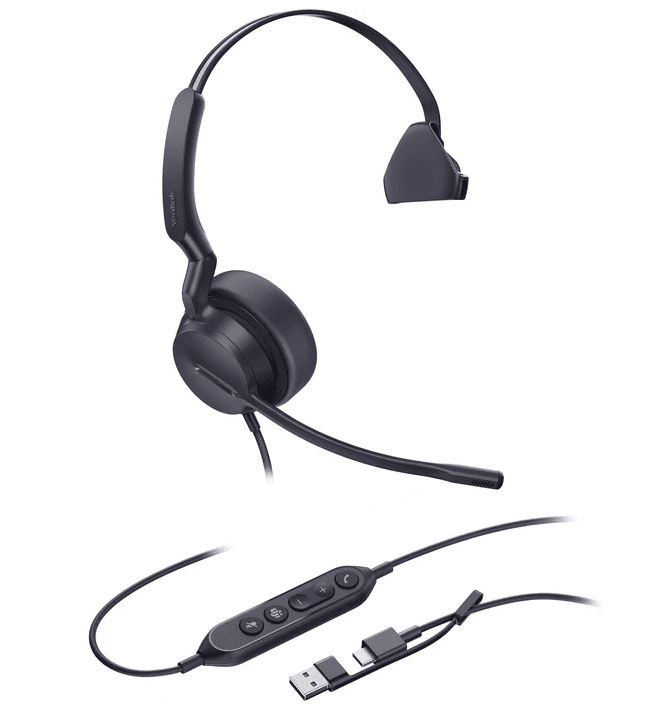
For Teams-first environments needing certified plug-and-play performance, the Yealink UH46 Mono Teams Headset (SKU: UH46-M-MS-C/A) adds native Teams certification and call control, cutting setup friction for IT teams. Browse the full Yealink Solutions range to compare current stock and pricing.
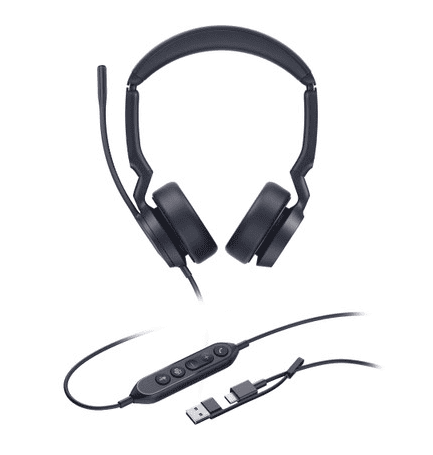
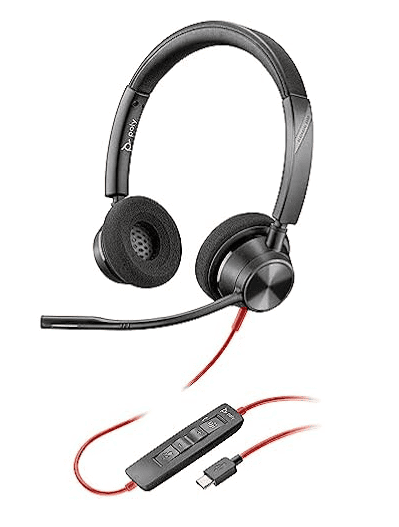
For hybrid staff who need wired reliability with premium comfort, the Poly Blackwire 3225 Headset (SKU: 209747-22) suits all-day wear across back-to-back meetings.
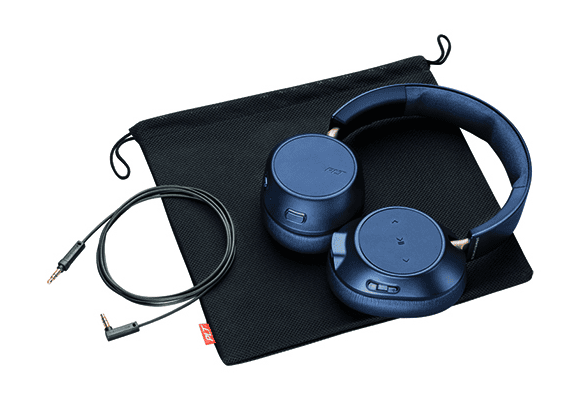
For staff who need wireless freedom without sacrificing call clarity, the Poly BackBeat GO 810 Wireless Headphones (SKU: BBGO600NAV) suits mobile and hybrid roles moving between spaces. The full Poly Solutions range sits alongside Yealink models at TECHOM Shop, making it easier to standardise a mixed fleet with confidence.
Frequently Asked Questions
#1. Is Poly vs Yealink Headsets mainly a Teams certification question?
Certification matters, but comfort, audio quality, and fleet management also shape the right choice for your team.
#2. Why Is My Headset Not Working after a Teams update?
This usually points to outdated firmware or driver mismatches. Keeping certified devices updated through Poly Lens or Yealink’s management platform prevents most of these issues.
#3. Can a business run both Poly and Yealink devices together?
Yes. Many organisations assign Yealink headsets to high-volume roles and Poly headsets to executive or hybrid staff.
Compare Poly vs Yealink Headsets for Your Business
Choosing between these two ranges should not stall your procurement timeline. With the right guidance, matching headsets to roles becomes straightforward.
TECHOM Systems Shop works with Australian businesses to simplify enterprise headset procurement, from single units to fleet-wide rollouts.
Ready to move forward? Compare Poly vs Yealink Headsets, shop enterprise-ready models, check current availability, or Get a Quote tailored to your organisation’s needs today.

Peter Pawlak, Director of Sales and Customer Advocate, brings over 15 years of experience helping ambitious business owners grow with confidence. His mission is to empower people to start, build, and run their businesses successfully, turning ideas into thriving ventures. Peter’s passion for business transformation and his results-driven approach have been key to guiding entrepreneurs toward faster and smarter growth.