





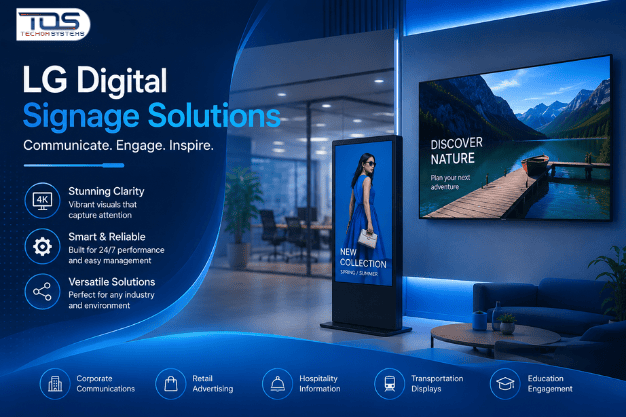
Businesses across Australia are rethinking how they communicate, both with customers walking through the door and with staff working across multiple sites. LG Digital Signage Solutions sit at the centre of that shift, turning static walls and noticeboards into responsive, centrally managed communication tools.
This article looks at where digital signage delivers genuine business value, how to build a defensible investment case, and what separates a smooth deployment from an ongoing support burden. It’s written for the evaluation stage, once the case for modernising communication has already been made internally, and the focus has shifted to choosing the right vendor and deployment approach.
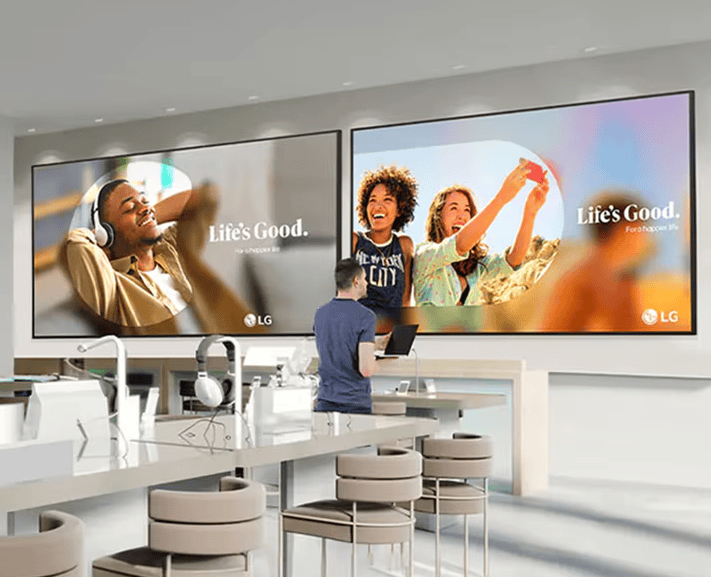
Why Digital Signage Decisions Deserve Executive Attention
A display screen looks like a straightforward purchase. The communication strategy behind it rarely is.
Content management, network reliability, and hardware lifecycle all shape whether a signage investment pays off or becomes another underused asset in a storeroom.
Consumer TVs vs Enterprise-Grade Displays: What Actually Changes
Many organisations start by asking whether a standard television could do the job just as well. The honest answer is rarely, once a display runs for extended hours in a commercial setting.
Enterprise-grade displays are built for continuous operation, brighter environments, and remote content management, none of which consumer televisions are designed to handle reliably.
Understanding what is an LG Commercial Display in practical terms comes down to build quality, operating hours, and manageability at scale, not just screen size. It’s a question worth answering properly before comparing any vendor shortlist.
Where Digital Signage Delivers Measurable Business Value
Retail: Converting Foot Traffic Into Engagement
Retail environments use digital signage to promote offers, guide customer flow, and reinforce brand presence at the point of decision.
Content can update centrally across every store, without a single poster reprint or courier delivery.
Corporate Offices: Consistent Internal Communication
Offices use signage to replace scattered emails and printed notices with a single, visible communication channel.
Reception areas, break rooms, and meeting room panels all benefit from consistent, centrally managed messaging.
Healthcare: Wayfinding and Patient Information
Healthcare facilities rely on clear, current information for wayfinding, wait times, and patient education.
Reliability matters more here than almost anywhere else, given the environment’s around-the-clock operating hours.
Education: Campus-Wide Messaging
Campuses use signage for timetables, emergency alerts, and event promotion across multiple buildings.
Centralised content management lets a small communications team manage dozens of screens without visiting each site.
Hospitality, Transport and Public Venues
Hotels, transport hubs, and public venues use signage for guest information, wayfinding, and real-time updates at scale.
In these environments, uptime and remote monitoring matter as much as picture quality.
Manufacturing and Government
Manufacturing sites use signage for safety messaging and production dashboards, while government facilities rely on it for public information and compliance communication.
Both environments prioritise reliability and centralised control over decorative design.
Content Management: The Difference Between a Display and a Communication System
A screen without a manageable content platform is just an expensive monitor. The software behind it is what turns hardware into a genuine communication system.
Centralised scheduling lets a single team update messaging across every site simultaneously, rather than relying on someone physically visiting each location.
This is one of the clearest differences between consumer displays and LG Digital Signage Solutions built specifically for commercial content management.
Building the Business Case: ROI and Total Cost of Ownership
Purchase price is only one part of the real cost equation. A more useful comparison looks at what each factor costs, or saves, once displays are running daily across an estate.
Cost Factor | Business Impact |
|---|---|
Display lifespan and duty cycle rating | Fewer replacements, lower long-term hardware cost |
Content management platform | Less manual update effort, faster campaign changes |
Remote monitoring and diagnostics | Fewer on-site support visits required |
Energy efficiency | Lower running costs across a multi-screen estate |
Warranty and local support | Reduced downtime risk for business-critical displays |
Viewed this way, LG Digital Signage Solutions represent an operating efficiency investment, not simply a hardware purchase line item.
Deployment Planning: What Separates a Smooth Rollout From a Support Headache
Most signage problems trace back to planning gaps, not hardware faults.
Deployment Factors Worth Confirming Early
|
Addressing these before purchase avoids the most common cause of underused signage: nobody owns it internally once it’s installed.
A Buyer’s Checklist Before You Shortlist Vendors
- What’s the required daily operating duration for each display?
- Does the environment need anti-glare or high-brightness panels?
- How many sites need centralised content management?
- What’s the internal process for content approval and scheduling?
- Who owns ongoing maintenance and support once it’s live?
A Simple Decision-Making Framework for Facilities and IT Leaders
- Define the primary business objective: engagement, information, or operational communication.
- Map required display count, size, and operating hours by site.
- Shortlist vendors based on manageability, not picture quality alone.
- Pilot one site before committing to a full estate rollout.
- Confirm long-term support and content management ownership.
Where LG Digital Signage Solutions Fit the Broader Ecosystem
Businesses researching LG Digital Signage Solutions usually shortlist them for consistent build quality and a manageable content ecosystem across multiple screens and sites.
LG Solutions extends beyond individual displays into the software and management tools that keep a growing screen estate genuinely maintainable over time.
For field teams and facilities staff managing multi-site rollouts, mobility matters too. Devices such as the LG K9 Dual SIM (SKU: LM-X210YMW) suit staff checking on regional sites day to day, while the LG G7 Black (SKU: LMG710EMW.AAUSBK) suits managers coordinating content approvals and support requests while on the move. Neither replaces the signage itself, but both support the team running it.
What Is an LG Commercial Display? Understanding the Distinction
A common question at this stage is what is an LG Commercial Display? In short, it’s a display engineered for extended commercial operating hours, remote content management, and consistent performance in retail, healthcare, education, and public-facing environments.
That distinction matters commercially. A consumer television bought for a boardroom often fails well before its commercial equivalent, once daily operating hours are properly factored in.
This is also where LG Digital Signage Solutions separate themselves from general consumer electronics: purpose-built for continuous, unattended operation rather than occasional evening use.
Key Takeaways
- Digital signage is a communication and operational investment, not just hardware
- Enterprise-grade displays outperform consumer TVs in continuous, commercial use
- Value varies by industry, from retail engagement to healthcare wayfinding
- Total cost of ownership matters more than the initial purchase price alone
- Deployment planning, especially content ownership, determines long-term success
- LG Digital Signage Solutions pair displays with manageable, scalable software
Frequently Asked Questions
#1. How is commercial signage different from a regular TV mounted on a wall?
Commercial displays are built for extended daily operation, brighter environments, and remote management, which standard televisions aren’t designed to handle.
#2. What is an LG Commercial Display best suited for?
Environments needing reliable, all-day operation and centralised content control, including retail, healthcare, education, and corporate spaces.
#3. How many screens can be managed from one content platform?
Centralised platforms typically scale from a handful of screens to several hundred across multiple sites, depending on the deployment and network setup.
#4. What’s a realistic lifespan for a commercial-grade display?
Well-maintained commercial displays typically run for many years of daily use, well beyond the practical lifespan of a consumer television used in the same role.
#5. Do small businesses need enterprise-grade signage, or is it just for large estates?
Even a single-site business benefits from reliable, easily updated signage, particularly if the screen runs for most of the trading day. LG Digital Signage Solutions scale down to single-site deployments just as readily as multi-site estates.
Ready to Modernise Your Communication Strategy?
Digital signage works best when it’s chosen to match real business objectives, not just available screen sizes. LG Digital Signage Solutions are worth evaluating early in that process, well before comparing individual panels.
If you’re ready to move forward, explore LG Solutions, compare commercial display options, and check current availability for your sites.
TECHOM Shop works with Australian organisations across retail, healthcare, education, and government to plan signage rollouts that hold up under daily commercial use.
Get a Quote today, and let our team help you build a communication strategy that scales with your business.

Peter Pawlak, Director of Sales and Customer Advocate, brings over 15 years of experience helping ambitious business owners grow with confidence. His mission is to empower people to start, build, and run their businesses successfully, turning ideas into thriving ventures. Peter’s passion for business transformation and his results-driven approach have been key to guiding entrepreneurs toward faster and smarter growth.